Showing posts with label public diplomacy. Show all posts

Sunday, April 18, 2010

Study Abroad and Culture

I was silent for around two weeks. I was preparing for International Academy of Business Disciplines Annual Convention in Las Vegas. I presented two papers, one project, and co-chaired four sessions. In addition to all this academic work, I tried to support IABD Press project. Shortly, I had quite a busy schedule during the conference.


One of the papers I presented was on the impacts of Fulbright Program entitled "More than a Touristic Visit: Scholar Exchanges as a Communication Method in Public Diplomacy". I introduced a three-level schema for intercultural encounters. The first level is tourism. Tourists, indeed, see a new country/culture, and go through a highly fabricated and controlled experience. But still, they go through an intercultural experience and they will have something to say about the country. The second level is exchange program participants. Scholars spend longer periods of time in a different country and go through a less controlled experience. After they return back to their home countries, they are considered as information sources about the host countries. The third (and for me the highest) level is the cultural ambassadors. People might start arguing for their host countries and might advocate their rights. We discussed how tourists and/or exchange program participants can be transformed into cultural ambassadors.


Given the international characteristic of the association and backgrounds of participants, we started discussing personal experiences and the importance of study abroad experience (Two people from the audience, both American, became cultural ambassadors of two different countries after their study/teach/live abroad experiences). Dr. Bonita Neff talked about her university - Valparaiso University -, and its commitment to increase the number of international exchange programs. I was amazed by the number of opportunities available for students to go abroad. I am not going to reinvent the wheel but I would like to recap some of the most important obstacles we discussed for intercultural discussions:

- Dominance of American data: We realized that most of the research we were doing was based on American data. For instance, I was discussing scholar exchanges through Fulbright program. Another presentation discussed face-ism through 2008 Presidential elections. The last presentation was on celebrity diplomacy, and of course, discussed mainly American celebrities. The volume and quality of data about the US is more than satisfactory, and we do not feel the need to look at other countries unless we are willing to do a comparative study.


- Dominance of American literature: Even the resources we cited were mainly from the US. Practically speaking, data and journals - maybe unintentionally - cause the scholars to focus solely on the United States.


- Cluster Study Abroad: When students are sent abroad by their colleges and universities to study abroad, they tend to travel in clusters, either with students from their own countries or from similar cultures. Therefore, even after spending a semester abroad, students have no idea about the host culture.


- Plain laziness: Many people just don't want to take the risk of moving abroad (usually overseas in the case of the United States). So, they choose to stay in their home country and do not interact with other cultures (well, maybe occasional interaction when they want to eat 'authentic' food).


In short, go abroad & live abroad. You don't need to come back as a cultural ambassador, but your intercultural experience will broaden your horizon.


PS 1: This is a photo of me, getting the Global Communication Award at IABD (hopefully, I will get another award for this weird handshake next year.)
Frankly speaking, I am proud to be part of such a diverse organization. This was my second year at IABD, I am looking forward to the convention in New Orleans next year! For further information about IABD, please visit http://www.iabd.org/. You can reach the press project for IABD 2009, St. Louis at http://www.iabdpress.org/ and for IABD 2010, Las Vegas at http://www.iabd2010.com/.

This blog post is also posted on http://efesevin.wordpress.com/ and http://placebranding.ning.com/.

Tuesday, March 9, 2010

Istanbul 2010 - An Opportunity for Branding

A few weeks ago, a friend of mine asked me what Istanbul 2010 was. She saw Istanbul 2010 ads at Heathrow Airport in London, but didn't have much idea about what exactly the ads tried to say. Istanbul has been selected as the European Capital of Culture 2010. Hosting international events, and being recognized by international organizations are good opportunities for promoting a place. Given the variety of events and images you can promote under 'culture', it is also a good branding opportunity. So how well did Turkey use it?


Okay, first of all, I have to admit one thing. I really didn't have a clear understanding of European Capital of Culture. I know there were three cities in 2010, and one was Pesc. What was the other one? (I just checked, it was Essen). Although some might be my ignorance, some might be because currently I am not in Europe but still, I am not sure how well the idea of ECOC is promoted.

Istanbul will be hosting several events throughout the year (If you plan to visit Istanbul, 2010 might be the best year to do so). You can find additional information about the event on Istanbul 2010 website. They also had interesting videos (some of which did not even show the subway system!) Although I have no idea why they chose the background music, the video below is quite good - especially the last 45-50 seconds (even the music makes sense). We see Turkish 'people' and scenes from daily life as well as important places (i.e. touristic attractions historical places). We have business people, small business owners, people walking, kids, even traffic jam on the video. The scenes pretty much describes both the modern and the historical, the Western and conservative, the serious and fun-having sides of Istanbul.


Though I do have one main question. Recently I started reading, writing, and thinking about authority and legitimacy in branding. When I look at Istanbul 2010 from that point of view, I cannot stop questioning whether they have the authority to claim brand ownership and legitimacy to brand the city. The names on the executive, advisory, and coordination boards (yes, there are three boards, maybe there is a fourth board on boards) are quite well-known people, high-level bureaucrats, and professionals. But where are the people? It seems to be an adequate project with a few shortcomings.

What Went Right
- Although public doesn't seem to be on any of the boards, everyone had the opportunity to submit a project to Istanbul 2010. In other words, if one wants to be a part of the event, it is possible.
- The domestic and (as far as I can see from my friend's anecdote) international media presence of the event was great. Everyone knows that there is something called Istanbul 2010 (we are just not so sure what it is).

What Went Wrong
- There doesn't seem to be an overarching theme. I don't like "a place where you can do everything" as a brand message and Istanbul 2010 subtly gives this message. Unfortunately can-do-everything messages never give a sense of inclusiveness. Even worse, you end up with a 'generic' place which is lost in messages. The website pretty much symbolizes this chaos.
- Project members seem to be very involved with Istanbul 2010 and be living with the idea. This is why the website fails to explain what Istanbul 2010 is. If you look at benefits for Istanbul part, you will see that Istanbul 2010 will make Istanbul the greatest place in Europe, maybe in the world. But there are no substantive explanation about why or how. (A trivia question: Which city was the ECOC 2009? What about ECOC 2011?)
- The communication methods don't go down to foreign publics. In other words, Istanbul 2010 uses mass media, and tourism fairs to promote. I couldn't find any people-to-people, Web 2.0, social media communication understanding. Right now, there doesn't seem to be much direct interaction between Istanbul 2010 and target audience.

In short, ECOC is a good regional promotion opportunity. Istanbul 2010 is a successful campaign. It might have been better if more communication/public diplomacy and less advertising techniques were used.


For those who are curious, ECOC 2009 were Vilnius and Linz, ECOC 2011 will be Turku and Tallinn.


This blog post is also posted on http://efesevin.wordpress.com/ and http://placebranding.ning.com/.

Saturday, February 27, 2010

Turkey and Public Diplomacy

As I am supposed to be focusing solely on my thesis nowadays, I am wasting quite some time surfing. I decided to google "public diplomacy turkey" and to read the recent developments. I believe, after Turkish MFA's two conferences inviting all the ambassadors to meet in Ankara, Turkey decided to introduce new foreign policy strategies. I felt obliged to put my two "kuruş" in.


On Jan 30th, 2010, Turkish PM issued a circular order, underlining the importance of public diplomacy and announcing the new official Public Diplomacy initiative. Institute of Public Diplomacy, was founded by a Turkish think-tank founded (where I was an intern six years ago). Suat Kinikoglu, a member of the Turkish Parliament, has mentioned the importance of communication and public diplomacy several times. He is also the director of Center for Strategic Communication - "a non-governmental organization in order to facilitate strategic communication for Turkey both at home and abroad." (though I have to say, I am not really comfortable with calling an institution an NGO when the director is an MP and is affiliated with the ruling party).


MFA announced that Turkish public diplomacy efforts will be seen on the internet. Although Turkey didn't catch the first wave of 'governments going online', Deputy Undersecretary's statements prove that Turkey has understood the importance of public diplomacy and two-way communication in foreign policy.


Last January, the minister and several ambassadors visited Mardin, where they talked with local residents and journalists. The following news article explains how "prominent Turkish ambassadors briefly abandoned the formal world of diplomacy to interact with people at a local coffehouse". It is good to see that our ambassadors can act in non-traditional environments. Our diplomatic corps are infamous for being elitist, these actions surely will help them to break this bad reputation. Turkey has been also engaged in several student exchange, economic cooperation, and cultural diplomacy activities.


Now it is time for action. We are already a latecomer to the race, but at least, we are explicitly demonstrating our interest for being present in the public diplomacy sphere. I see four important problems: exploitation of the term, lack of strategy, unclear message, and targeting audiences.


Even though we recently learned the term, we love calling everything 'public diplomacy', for instance the visit in Mardin. Apart from the fact that Mardin is a city in Turkey, I really cannot justify calling an informal event as public diplomacy. The minister and some ambassadors decided to walk around the town with some journalists during a conference in Mardin. I tried to find similar news articles in foreign media, but I couldn't find any. Mardin is a fascinating city, is the home of several historical sites (and the world tallest men). But if there is no intention to create any communication bridges between Turkey and target audiences, this kind of public diplomacy attempts, one-way communication strategies are likely to fail. If we keep calling everything public diplomacy, the value of real PD projects will be neglected.


I cannot see a clear strategy in the existing student exchanges and other cultural/economic activities. All projects seem to have short term interest, such as constructing a building, hosting a student, and promoting an artist. If we want to justify the budgets for PD projects - and it is better if we do -, we should have clear quasi-measurable strategy objectives.


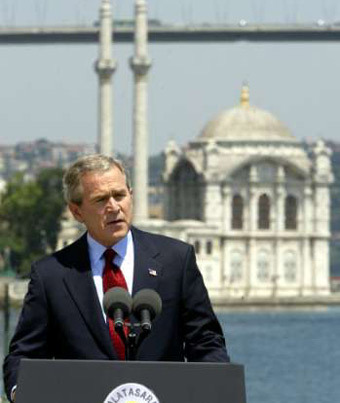
G. Bush in Istanbul for NATO Conference in 2004Modern Istanbul

Turkey's biggest challenge (and opportunity) is that there are several messages we can communicate due to our historical and cultural roots.One of our favorite messages is being "the bridge between the East and the West". Visualized by Bush's speech during the NATO Conference in 2004, we love to claim that we have roots in the Eastern and Western cultures. Although this claim represents the reality to an extent, it sometimes reflects an inconsistent position instead of a unifying/unbiased position. Especially when our government sometimes tries to use our eastern roots as an alternative in EU negotiations, our inclusive approach becomes less persuasive. Another message is presenting the modern side of Turkey. Although it is more appealing to some audiences, it doesn't reflect the Turkish reality entirely. When you consider the various cultures of Anatolia (some of which have lived in the region years ago, and some of which are still living), we can come up with several different messages. Yet, still the important thing is to come up with consistent messages that reflect the reality instead of highly crafted propagandist messages.


Last but not the least, we should define and prioritize our audiences. Our current foreign policy strategy, Strategic Depth, aims to create a multi-dimensional approach in which Turkey tries to build up strong relations with anyone and everyone. From a communication point of view, it is neither desirable nor feasible.


In short, Turkey has the potential to become a well-known brand and a globally respected actor in international politics. It is time to stop calling everything public diplomacy, to leave our political differences aside, and to come up with PD strategies.


This blog post is also posted on http://efesevin.wordpress.com/ and http://placebranding.ning.com/.

Wednesday, February 3, 2010

Who are you? Legitimacy in Place Branding

I submitted an article for a student publication last week on public diplomacy and place branding. Shortly speaking, I describe how and why we are using public diplomacy and grassroots movements in a regional branding project. I am not going to discuss the details of the article (-as both the article and the project are under review).Though ever since, I started thinking about legitimacy in place branding. In other words, who gave us the authority to work on the regional branding project? Even further, who gave a committee the authority to brand the place? ABS had a great issue on "Legitimacy in the Modern World" last year. However, branding & legitimacy necessitates further research and an explanation for itself (rather than being discussed under a general legitimacy title).


Therkelsen & Halkier* remind us about a classification in branding: inside-out and outside-in. A good branding campaign chooses the former style, and tries to find the brand identity in a place. You are supposed to discuss the local values, traditions, life, actors etc... Does anyone else see the irony here? As an outside consultant, you are expected to lecture local figures about their own values.. Now, even if you have an official title, even if you are a politician, governor, president, or a king; you are never given the authority to build up an identity for your citizens/subjects. So, how can you even think about creating a place brand?

The place branding project that I am a proud part of, therefore, underlines the importance of grassroots movements and public diplomacy. By engaging with the local stakeholders, by raising awareness, and by talking with them about how they see their own home towns, we aim to create credibility, legitimacy, and eventually a long-lasting brand for the region. In communication, it is a known fact that meaning is 'negotiated' and created among several parties. Before setting sail to reach our target audiences, we negotiate the region's meaning with the residents. We encourage them to be a part of the branding. The entire project is based on creating a community pride within people.

Once the brand identity is negotiated with local people, and a sense of social involvement is created, it is time to reach out to the target audiences. Again, public diplomacy and grassroots movements are very effective ways especially during the initial stages of the project. By creating direct, people-to-people communication bridges, you are automatically involved in the 'negotiation' process, and you can create more effective and persuasive brand messages. Moreover, as you enjoy the opportunity to receive instant feedback, you can use your projects as focus group studies as well.

I still have ethical doubts about legitimacy and place branding. As far as I can see, grassroots movements is the best course of action (although I really don't know how effective they will be in larger populations) because firstly you strengthen the community spirit within an inclusive campaign. Secondly, you don't fabricate a brand image but use an inside-out technique. Even before you start disseminating your message, you guarantee a long-lasting brand. And lastly, by sharing your messages through public diplomacy, you build real relations with your audience and hear their feedback. Shortly, if you want to be legitimate, talk with 'everyone'.

* Therkelsen, A., & Halkier, H. (2008). Contemplating Place Branding Umbrellas. The Case of Coordinated National Tourism and Business Promotion in Denmark. Scandinavian Journal of Hospitality and Tourism, 8(2), 159-175. doi:10.1080/15022250802221229
This blog post is also posted on http://efesevin.wordpress.com/ and http://placebranding.ning.com/.